

The deeper meaning of Zakariya’s prayer “رَبِّ لَا تَذَرْنِي فَرْدًا” and why it still speaks to us today
There are moments in life when we feel deeply alone. Not just physically, but emotionally, spiritually, or energetically disconnected.
In those moments, a simple plea may rise from within: “Do not leave me alone.” It is not a cry of despair, but a sacred prayer for connection, for belonging, and for reassurance that we are still seen. One such prayer appears in the Qur’an, spoken by Prophet Zakariya (peace be upon him):
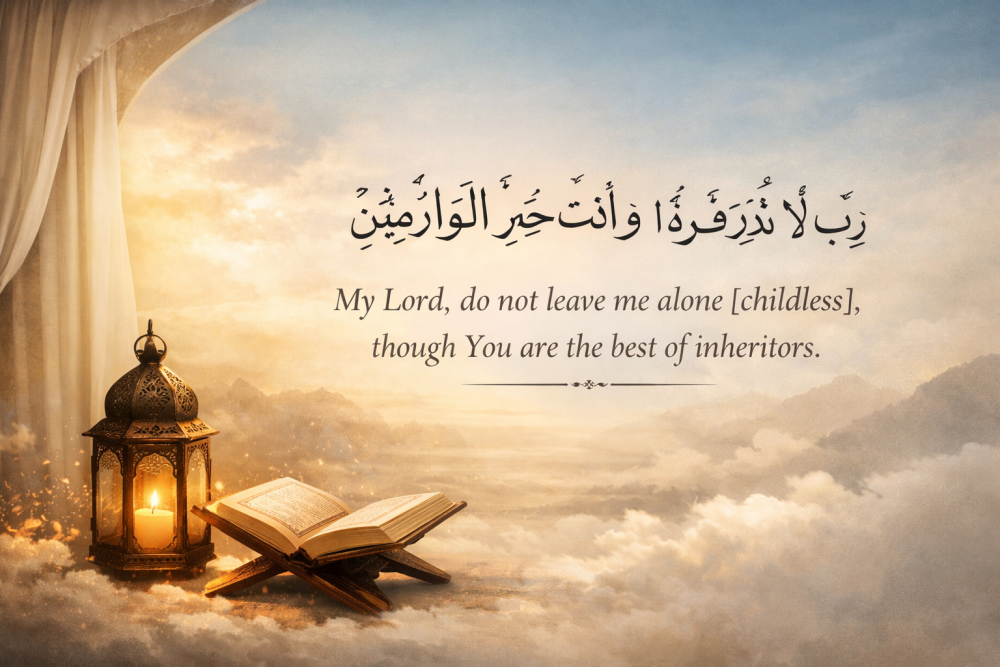
رَبِّ لَا تَذَرْنِي فَرْدًا وَأَنتَ خَيْرُ الْوَارِثِينَ
“My Lord, do not leave me alone [childless], though You are the best of inheritors.”
(Surah Al-Anbiya, 21:89)
Although this verse refers to the longing for a child, its meaning reaches beyond parenthood. It touches something deeply universal: the desire to matter, to be part of something meaningful, to leave behind a trace of who we are, and to feel our lives are connected to a greater whole.
This verse is not simply about the wish for offspring. It is about longing for continuity, contribution, and connection. It is a reminder that even in our private prayers, we can be fully human: longing, trusting, and surrendering all at once.
Self-awareness begins with honest inner dialogue
In my Unbox The Real You™ work, I refer to the BEMA™ Methodology, The Four Dimensions of Change: Body, Emotions, Mind and belief system, and Accountability to action. This short verse powerfully mirrors each of those dimensions.
Self-awareness begins with honest inner dialogue. Try journalling your answers to the questions below, start a conversation with yourself. That is where reconnection begins.
Body: the ache of physical aloneness
Zakariya’s prayer was rooted in physical reality. He was asking not to leave this world without someone to carry his name, his message, or his energy forward. Many of us today feel this in different forms; being alone in parenting, unsupported in our health, or disconnected from touch and community.
Ask yourself: Where in my life do I feel physically unsupported or isolated? Is it in my home, my body, or my day-to-day routine?
Emotions: the courage to admit longing
There is vulnerability in asking. Many people suppress their desires because they fear disappointment or rejection. But emotional truth is a key to transformation. Zakariya asked from the heart. He did not hide behind pride or spiritual avoidance.
Ask: What do I truly long for, but have not dared to express out loud?
Mind and belief system: faith without control
Zakariya acknowledged divine order. “You are the best of inheritors.” Even as he asked, he affirmed that all things ultimately belong to God. This is not passive detachment. It is active trust. It reflects a mindset that allows desire and surrender to coexist.
Ask: Do I trust that what is mine will not pass me by?
What beliefs am I still holding about lack, worthiness, or divine timing?
Accountability to action: the act of speaking
Even though God knows what we need, Zakariya voiced his request. He moved into active engagement with the divine. In your own life, this could mean praying, journalling, creating space for your goals, or even reaching out to someone.
Ask: Have I taken any action in alignment with my inner needs; or have I only been thinking about them?
The unconscious speaks: dreams, symbolism and silence
In the language of the unconscious, loneliness is not always a negative symbol. It can represent the soul’s desire to return to source, or the call to reconnect with parts of the self that have been exiled or neglected.
If this verse appears in your mind during prayer, meditation, or a dream, it may not be about physical solitude at all. It could be your own inner voice asking you not to abandon the parts of you that still need nurturing; your inner child, your unspoken dream, or your unseen self.
The phrase “You are the best of inheritors” reminds us that even when relationships fall away, roles end, or identities shift, our essence is still held. Our worth is not erased. Our presence is not forgotten.
You are not truly alone
If you are in a season where you feel disconnected or overlooked, let this verse be your reminder that your presence matters. You are allowed to ask. You are allowed to long. And you are also held by something greater than your circumstances.
The Real You is not measured by how many people surround you. It is measured by the truth you carry, the light you nurture, and the silent knowing that you are already part of something eternal.
May your voice rise through stillness.
May your dreams speak what words cannot.
And may your inner light remind you: You are never truly alone.