

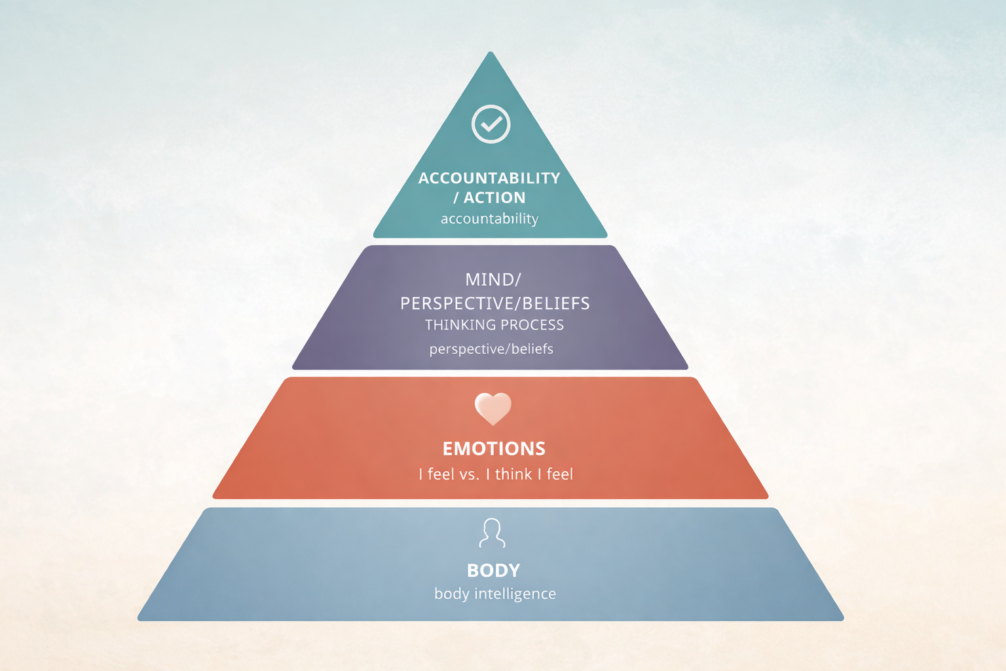
Real change rarely happens through ideas alone. Many people understand what needs to change in their lives, yet they still feel stuck in familiar patterns. Insight without alignment does not create transformation.
Through years of mentoring individuals navigating transition, leadership pressure, and personal reinvention, I observed a consistent pattern. When change failed to hold, it was usually because one dimension of life had been addressed while the others were ignored.
The Four Dimensions of Change explain why transformation sometimes begins with enthusiasm but fades quickly. Sustainable change happens when the body, emotions, mind, and actions move in alignment. This framework forms the foundation of The Four Dimensions of Change – BEMA™ Methodology that guides my work.
Why Change Often Fails
Many people approach growth intellectually. They read books, attend workshops, or consume inspiring content. They gain knowledge and clarity about what they should do differently.
However, knowledge alone rarely changes behaviour. The body may still carry fatigue or stress. Emotional reactions may remain unresolved. Habits continue to follow familiar patterns. Without alignment across multiple levels of experience, insight stays theoretical.
This is why people often say they “know what to do” but still struggle to follow through. True change requires coherence between what we understand and how we live.
The First Dimension: The Body
The body is often the most overlooked dimension of transformation. Yet the body continuously signals whether we are living in alignment or strain.
Physical tension, exhaustion, and chronic stress frequently indicate that something in our life structure needs attention. When the body is ignored, people attempt to solve problems purely through mental effort. Over time this creates more pressure rather than clarity.
Listening to the body restores grounding. It reveals whether we are moving too fast, pushing beyond capacity, or ignoring essential needs. The body anchors awareness in the present moment and stabilises the entire change process.
The Second Dimension: Emotions
Emotions are information. They reveal how we are processing experiences, relationships, and internal expectations.
When emotions are dismissed or suppressed, they often resurface as resistance, anxiety, or frustration. Many people attempt to make rational decisions while their emotional landscape remains unresolved.
This creates internal conflict. The mind may decide to move forward, but emotions pull in another direction.
Understanding emotional patterns helps us recognise what truly matters to us. Emotional awareness also prevents unconscious reactions from shaping our choices.
When emotions are acknowledged and integrated, decision making becomes clearer and more grounded.
The Third Dimension: The Mind
The mind interprets experience. It builds narratives about who we are, what we believe is possible, and how we respond to challenges.
Many limitations originate from inherited beliefs, cultural expectations, or past experiences that have quietly shaped our thinking.
The mind can support growth, but it can also defend outdated identities.
When we examine our mental patterns honestly, we begin to see the assumptions guiding our decisions. This awareness allows us to update our thinking so it reflects our current reality rather than old narratives.
Mental clarity strengthens the other dimensions of change.
The Fourth Dimension: Action
Action completes the cycle of transformation. Without action, awareness remains an internal exercise.
Aligned action does not mean constant activity or forceful productivity. It means choosing steps that reflect clarity across the other dimensions.
When the body feels stable, emotions are acknowledged, and the mind has examined its assumptions, action becomes more precise. Decisions feel less reactive and more intentional.
Action is where insight becomes visible in daily life.
Alignment Creates Intuition and Clarity
When the body, emotions, mind, and actions move together, people experience something many describe as intuition.
Intuition is often misunderstood as something mystical or mysterious. In reality, it frequently emerges when internal signals are no longer in conflict. Alignment reduces noise within the system.
Clarity becomes easier because competing signals are no longer pulling in different directions.
This is why many people find that intuition strengthens when their life becomes more coherent.
The Four Dimensions as a Practical Framework
The Four Dimensions of Change provide a simple but powerful framework for evaluating where alignment may be missing.
When someone feels stuck, overwhelmed, or uncertain about direction, examining these four areas often reveals the imbalance.
- Are you physically depleted?
- Are unresolved emotions influencing decisions?
- Are outdated beliefs shaping your interpretation of events?
- Are your actions consistent with what you say matters most?
These questions bring practical structure to self-reflection.
If you want to explore the deeper role awareness plays in transformation, you may also find it useful to read From Self-Awareness to Self-Leadership: The BEMA™ Method, where I explain how recognising patterns becomes the first step toward meaningful change.
Continue the Conversation
If you’re ready to Unbox with Sahar, book your strategic clarity session.